
You’re here because customers are churning (or you’re worried they’re about to) and the spreadsheet isn’t cutting it anymore.
Almost every customer success platform hides its pricing behind a demo call, and most “best of” roundups read like they were written by someone who never opened a single tool.
So here’s the honest version. We compared the 8 best customer success tools in 2026: what each one actually does, what it really costs (including the numbers vendors don’t publish), and who it’s genuinely right for.
The best customer success tools at a glance
-
Senja: best for customer delight and advocacy, with thank yous, gifts and social proof (free to start)
-
Vitally: best for product-led SaaS startups (reported from ~$299/month)
-
ChurnZero: best all-rounder for mid-market teams (quote-only)
-
Custify: best for small teams that want hands-on onboarding (quote-only)
-
Planhat: best for teams that want a custom data model (quote-only, unlimited seats)
-
Gainsight: best for enterprise CS organisations (quote-only)
-
Totango: best for modular enterprise teams (free tier available)
-
Pylon: best for running support and success in one tool (from ~$59/seat/month)
What are customer success tools?
Customer success tools help you keep the customers you’ve already won. They pull product usage, billing and support data into one place, score each account’s health, and flag the ones about to churn, so your team can step in before the cancellation email arrives.
Most of them also automate the busywork: onboarding sequences, renewal reminders, QBR prep, and playbooks that tell your CSMs what to do next.
But there are two halves to customer success. One half is catching problems: health scores, churn dashboards, escalations. The other half is creating delight: knowing your customers, thanking them, and turning their wins into growth. Most platforms only do the first half. Keep that in mind as you read. It’s why the first tool on this list looks a little different from the rest.
1. Senja — best for customer delight and advocacy
Full disclosure: Senja is our product. It’s also not a Gainsight replacement, so let us be precise about where it fits.
Senja is customer success software built on customer delight. The platforms below tell you which accounts are healthy, but they have no delight surface. They’re dashboards. Senja is the delight layer you run next to them (or instead of them, while you’re still small): know your customers, thank them like it’s still day one, and turn their success into yours.
Standout features:
-
See every customer who deserves your attention: purchases, upgrades, reviews and feedback in one place, with recent Stripe upgrades pulled in automatically
-
Thank Yous: send a personal note, video or GIF in seconds, and add e-gifts, coupons and discount codes, feature unlocks or a charity donation
-
See who opens and redeems every gift, and get customer reactions delivered straight to Slack
-
Make delight a team habit with thank you streaks, leaderboards and daily Slack recaps
-
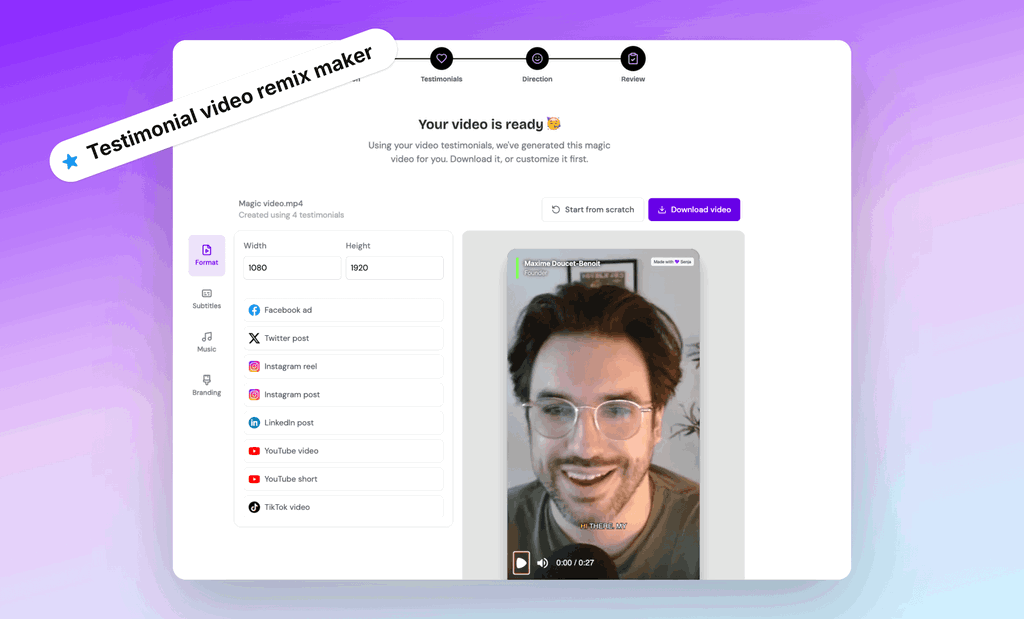
Turn wins into testimonials, widgets and Walls of Love you can drop into renewal decks, ads and landing pages
Pricing: Free plan (collect up to 15 testimonials, unlimited widgets). Paid plans from $29/month. No demo call required. Pricing is public.
Watch out for: No health scores or churn forecasting. That’s Gainsight and Vitally territory. Senja is what makes customers want to stay, and say so in public.
2. Vitally — best for product-led SaaS startups
Vitally is the modern favourite for startups and mid-market SaaS teams. The interface feels more like Notion than a legacy CRM: Docs, Boards, and collaborative hubs you can share with customers.
Standout features:
-
Real-time product usage data feeding customisable health scores
-
Docs and Hubs: customer-facing workspaces for onboarding plans and success reviews
-
Strong native integrations with Segment, HubSpot, Salesforce and Stripe
Pricing: Reported from around $299/month, priced by number of customer accounts. Mid-market teams typically land between $800 and $2,500/month. One of the few platforms here you can trial without a sales call.
Watch out for: G2 reviewers mention an overwhelming dashboard and navigation that got more confusing after recent UI changes.
G2 rating: 4.5/5
3. ChurnZero — best all-rounder for mid-market teams
ChurnZero is the highest-rated of the dedicated mid-market platforms, and the one we’d point most established B2B SaaS teams at first.
Standout features:
-
ChurnScores built on real-time product usage tracking
-
In-app communication: walkthroughs and announcements inside your product, which is rare for this category
-
Plays for automating onboarding, renewals and save motions, plus a growing set of AI assistants
Pricing: Quote-only. Reported contracts mostly land between $15,000 and $40,000/year for mid-market teams, plus implementation.
Watch out for: Setup is a real project, and some capabilities (like API access) have moved behind the Enterprise tier.
G2 rating: 4.7/5
4. Custify — best for small teams that want hands-on onboarding
Custify sells on simplicity and service: their team helps you build your initial setup, health scores and playbooks instead of handing you an empty platform.
Standout features:
-
Concierge onboarding: Custify configures the platform with you
-
Customer 360 view pulling CRM, billing and support data automatically
-
Multiple health scores per customer segment
Pricing: Quote-only. Review sites report starting around $899/month for up to 3 seats.
Watch out for: You still build segments and metrics from scratch (reviewers wish there were more templates), and there’s no native NPS collection or mobile app.
G2 rating: 4.7/5
5. Planhat — best for teams that want a custom data model
Planhat is the most flexible platform on this list, closer to “build your own customer platform” than an out-of-the-box CS tool, with custom objects, fields and formulas.
Standout features:
-
Highly customisable unified data model
-
Unlimited users on every plan, so your whole company can see customer data
-
Polished dashboards and customer portals
Pricing: Quote-only, structured around customer accounts and modules. No reliable public starting price, but the unlimited seats make the economics interesting for bigger teams.
Watch out for: The flexibility comes with a demanding learning curve. Expect real data-modelling work before you see value.
G2 rating: 4.6/5
6. Gainsight — best for enterprise CS organisations
Gainsight created this category and remains the enterprise default. It’s the deepest platform here — and the heaviest.
Standout features:
-
Health scorecards and Timeline: the reference implementation of CS health scoring
-
Journey Orchestrator for complex lifecycle automation
-
A growing suite around the core: product analytics (PX), conversation intelligence (Staircase AI) and customer education (Skilljar)
Pricing: Quote-only. Reported pricing runs roughly $150–$300 per user per month, with implementation projects often adding $30,000+.
Watch out for: Reviewers consistently say Gainsight needs a dedicated admin, and the interface shows its age. If you don’t have an ops person for it, look elsewhere.
G2 rating: ~4.5/5
7. Totango — best for modular enterprise teams
Totango merged with Catalyst in 2024 and now covers everything from a free entry tier to full enterprise deployments, built around modular “SuccessBLOCs”, pre-built toolkits for each stage of the customer journey.
Standout features:
-
SuccessBLOCs for the fastest out-of-the-box start in the enterprise segment
-
Catalyst’s well-liked interface, now part of the same company
-
Unison, an AI engine focused on churn prediction
Pricing: Historically the most transparent enterprise option: a free tier, with paid plans reported from around $249/month. Packaging has been changing since the merger, so check current numbers.
Watch out for: Reviewers report performance lags with large datasets, and it has the lowest G2 score of the group.
G2 rating: 4.3/5
8. Pylon — best for running support and success in one tool
Pylon is the odd one out: a B2B post-sales platform that combines support ticketing, customer success and a knowledge base, built for teams that live in Slack with their customers.
Standout features:
-
Native Slack, Teams and Discord ticketing that turns threads into trackable issues
-
Support and success workflows running on the same conversation data
-
AI support agents and a fast-shipping product (they raised a $31M Series B in 2025)
Pricing: Published per-seat pricing (rare in this list) from around $59/seat/month, with add-ons for AI usage and account intelligence.
Watch out for: It’s a young product. Health scoring and enterprise reporting are thinner than the dedicated platforms above.
G2 rating: 4.7/5 (from a smaller number of reviews)
How to choose the right customer success tool
Ignore the feature matrices. The decision mostly comes down to your stage:
-
Under ~200 customers or no dedicated CS team yet: you probably don’t need a health-score platform. A good support tool plus Senja (to know your customers, thank them and collect proof) will take you surprisingly far
-
Growing SaaS with a small CS team: Vitally or Custify, depending on whether you’d rather self-serve or be onboarded by hand. Pylon if support and success are the same people
-
Established mid-market team: ChurnZero is the highest-rated pick. Planhat if you have opinionated data needs
-
Enterprise: Gainsight or Totango. Budget for implementation and an admin either way
And whichever you pick: don’t stop at dashboards. Health scores only tell you which customers are at risk. You still have to make them want to stay.
FAQs about customer success software
What is the best customer success software?
For most mid-market SaaS teams, ChurnZero. It’s the highest-rated dedicated platform on G2 (4.7/5). Startups tend to prefer Vitally for its modern interface and transparent trial. Enterprises still default to Gainsight. And whichever platform you run, Senja covers the half they don’t: customer delight.
How much do customer success tools cost?
More than the websites suggest. Only Pylon, Vitally and Totango publish meaningful pricing. For the quote-only platforms, reported contracts range from roughly $10,000 to well over $100,000 per year once you include implementation.
What’s the difference between a customer success tool and a CRM?
A CRM tracks deals before the sale. A customer success tool tracks the relationship after it: usage, onboarding progress, renewal risk, and the thank yous that keep it warm. Most CS tools sync with your CRM rather than replace it.
Do small teams need a customer success platform?
Usually not yet. If one person can still know every account personally, a dashboard adds process without adding insight. Spend the money on making customers successful, and on thanking them when they are.
Turn customer success into new revenue
Every tool on this list helps you find your happy customers. Senja helps you delight them with personal thank yous and gifts, coupons and feature unlocks, then turn their wins into testimonials that grow your business.
It’s free to start, and it takes minutes to thank your first customer. Start delighting customers today.